Can a Torn Acl Get Better Then Worse Again?
Torn ACL
A circuitous set of tendons and ligaments help stabilize and support the genu articulation with its every movement, from a simple walking step to an ice skater's bound. Unfortunately, these tissues are vulnerable to injury. In particular, tears of the anterior cruciate ligament (ACL) are quite common among athletes and active individuals of all ages.
- What is the ACL?
- What is an ACL tear?
- Who tears their ACL?
- How practice you lot tear your ACL?
- Symptoms: What happens when the ACL is torn?
- What should I do if I think I have torn my ACL?
- How is a torn ACL diagnosed?
- Can ACL tears be treated nonsurgically?
- When is ACL surgery necessary?
- Articles for further reading
What is the ACL?
The anterior cruciate ligament (ACL) is one of iv major ligaments in the knee joint. Information technology helps maintain the knee'southward rotational stability and prevents the tibia (shinbone) from slipping in front of the femur (thighbone).
The ACL is particularly vulnerable to injury during athletic activity or equally the consequence of touch, and a torn ACL is a common injury in athletes of all levels. Information technology is especially common in sports with a lot of leg planting, cut and pivoting, such as soccer, basketball, skiing and football. Surgery is often required to repair an ACL tear.
What is an ACL tear?
An ACL tear is when the anterior cruciate ligament becomes partially or completely ruptured. Once torn, an ACL cannot regrow or heal on its own.
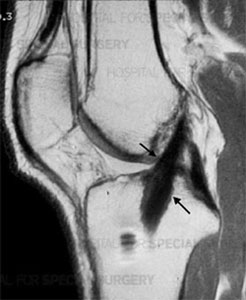
Side-view MRI showing a healthy, intact ACL
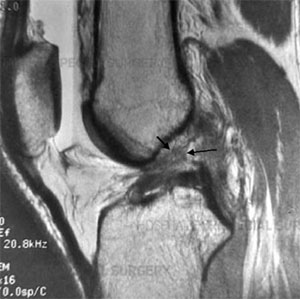
Side-view MRI showing a completely torn ACL
Who tears their ACL?
People of all ages, physical conditions and abilities can tear an ACL. Active women feel a higher incidence of ACL injuries than men because their biomechanics tend to put more stress on their knees.
ACL injuries are also common in children, especially as youth sports get increasingly competitive. Until recently, ACL handling for children and adolescents was exclusively nonsurgical. This was because tradtional ACL surgery techniques could crusade growing children to develop a leg length discrepancy or growth deformity. All the same, newer surgical techniques take made surgical repair an option for many kids and teens.
How do yous tear your ACL?
A partial or complete ACL tear (rupture) often occurs during a sudden twisting movement, in which a person stops apace and changes direction, especially while pivoting or landing after a jump.
A sudden, high-free energy bear upon to the genu can also cause the ACL to tear. ACL tear injuries are oftentimes accompanied by injuries to other tissues in the human knee, including cartilage or additional knee ligaments, such every bit the MPFL.
Symptoms: What happens when the ACL is torn?
Common symptoms of a torn ACL include:
- popping sound at the time of injury
- hurting
- swelling
- articulatio genus instability
When a person tears their ACL, they frequently report hearing a popping sound at the moment that the tear occurs. The articulatio genus volition quickly dandy and, in many cases, feel unstable. However, in some less astringent tears, these symptoms may be mild. This is especially the case in people whose lifestyles do not involve intense concrete activity.
If the ACL is completely torn, there will be instability in the genu that volition cause feelings of sudden shifting or buckling. People will exist unable to:
- jump and land on the genu
- accelerate and then change directions
- rapidly pivot on the knee
What should I do if I think I have torn my ACL?
Immediately later an ACL injury, it is important to:
- Stay off the leg and drag information technology.
- Subtract the inflammation in the knee by:
- Applying ice.
- Taking nonsteroidal anti-inflammatory drugs (NSAIDs) such as ibuprofen.
- Consult an orthopedist or sports medicine physician as shortly as possible.
The physician will determine how bad the ACL injury is and review whether nonsurgical treatment and rehabilitation will be plenty or if orthopedic surgery is necessary. Whether or not surgery is performed, physical therapy volition be disquisitional to strengthen the muscles surrounding the articulatio genus and improve its range of motility.
How is a torn ACL diagnosed?
A dr. tin can normally diagnose a torn ACL from a concrete exam, although magnetic resonance imaging (MRI) is helpful. Getting an MRI is likewise of import to find out if other parts of the knee accept been injured.
Tin can ACL tears be treated nonsurgically?
Surgery is not necessary for all patients. The chief conservative treatments are rest and anti-inflammatory medication to reduce pain and inflammation.
Some patients may too be fitted with a leg brace for apply during activities that place stress on the knee. The doctor will also prescribe a grade of physical therapy. This rehabiliation regimen is extremely of import for preventing future injury.
Possible disadvantages of nonsurgical treatments
The long-term consequence for patients who are treated nonsurgically varies. Those who return to unrestricted activity are probable to experience some knee instability. Pain may exist associated with the physical therapy regimen. In the absence of an intact ACL – even when no other injury is nowadays – the menisci (pads of cartilage that cushion the bones that come across at the articulatio genus joint) have a college risk of injury. If a tear forms in one or both menisci of the knee, pain and swelling may occur. More importantly, a damaged meniscus increases a patient's risk of developing osteoarthritis of the genu later in life.
When is ACL surgery necessary?
The choice to have surgery is commonly based on the patient's lifestyle. In athletes and other people of any age who wish to continue doing physically enervating activeness, an ACL reconstruction surgery is frequently needed.
If the injury is not too severe, some patients who do non demand to perform intense athletics or physical labor may exist able to go without surgery and notwithstanding lead active, healthy lifestyles. Many people with torn ACLs who receive conservative, nonsurgical treatments are able to swim, jog and use well-nigh equipment constitute at the gym or wellness guild.
Articles for further reading
Below, explore articles and other content on ACL injuries or select Treating Physicians to find the best doctor or surgeon at HSS to suit your specific condition and insurance.
Back in the Game patient stories
Weblog posts
In the news
Source: https://www.hss.edu/condition-list_torn-acl.asp#:~:text=An%20ACL%20tear%20is%20when,or%20heal%20on%20its%20own.
0 Response to "Can a Torn Acl Get Better Then Worse Again?"
ارسال یک نظر