Which Reading Strategy Can Help You Identify the Author's Purpose?
Comprehension: The Goal of Reading
Comprehension, or extracting meaning from what you read, is the ultimate goal of reading. Experienced readers take this for granted and may non appreciate the reading comprehension skills required. The process of comprehension is both interactive and strategic. Rather than passively reading text, readers must analyze it, internalize it and make it their own.
In order to read with comprehension, developing readers must be able to read with some proficiency so receive explicit instruction in reading comprehension strategies (Tierney, 1982).
 Strategies for reading comprehension in Read Naturally programs
 General Strategies for Reading Comprehension
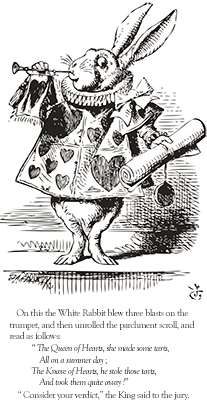
The process of comprehending text begins before children can read, when someone reads a moving-picture show book to them. They listen to the words, run across the pictures in the book, and may kickoff to associate the words on the page with the words they are hearing and the ideas they represent.
In guild to learn comprehension strategies, students need modeling, practice, and feedback. The cardinal comprehension strategies are described beneath.
Using Prior Noesis/Previewing
When students preview text, they tap into what they already know that will help them to understand the text they are about to read. This provides a framework for any new information they read.
Predicting
When students make predictions about the text they are most to read, it sets up expectations based on their prior cognition virtually similar topics. As they read, they may mentally revise their prediction as they proceeds more than information.
Identifying the Main Idea and Summarization
Identifying the primary idea and summarizing requires that students make up one's mind what is important and then put it in their own words. Implicit in this process is trying to empathize the author's purpose in writing the text.
Questioning
Asking and answering questions about text is another strategy that helps students focus on the meaning of text. Teachers can help by modeling both the process of asking proficient questions and strategies for finding the answers in the text.
Making Inferences
In order to make inferences about something that is not explicitly stated in the text, students must learn to depict on prior knowledge and recognize clues in the text itself.
Visualizing
Studies have shown that students who visualize while reading have improve recall than those who do not (Pressley, 1977). Readers can accept reward of illustrations that are embedded in the text or create their ain mental images or drawings when reading text without illustrations.
Strategies for Reading Comprehension: Narrative Text
Narrative text tells a story, either a truthful story or a fictional story. At that place are a number of strategies that volition help students empathize narrative text.
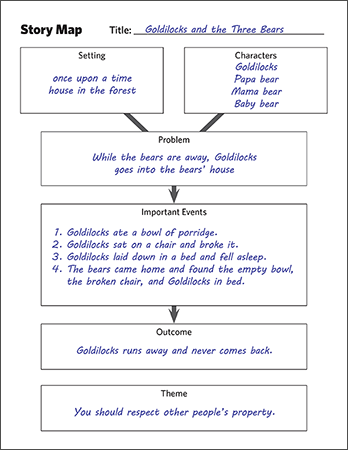 Story Maps
Teachers tin have students diagram the story grammer of the text to heighten their awareness of the elements the author uses to construct the story. Story grammar includes:
- Setting: When and where the story takes place (which tin alter over the course of the story).
- Characters: The people or animals in the story, including the protagonist (principal character), whose motivations and actions bulldoze the story.
- Plot: The story line, which typically includes 1 or more problems or conflicts that the protagonist must address and ultimately resolve.
- Theme: The overriding lesson or main idea that the author wants readers to glean from the story. Information technology could be explicitly stated equally in Aesop's Fables or inferred by the reader (more common).
Printable story map (blank)
Retelling
Asking students to retell a story in their own words forces them to analyze the content to make up one's mind what is of import. Teachers can encourage students to become beyond literally recounting the story to drawing their own conclusions about it.
Prediction
Teachers tin inquire readers to brand a prediction about a story based on the title and any other clues that are available, such every bit illustrations. Teachers tin afterward ask students to find text that supports or contradicts their predictions.
Answering Comprehension Questions
Asking students different types of questions requires that they notice the answers in different ways, for example, by finding literal answers in the text itself or by cartoon on prior noesis and then inferring answers based on clues in the text.
Strategies for Reading Comprehension: Expository Text
Expository text explains facts and concepts in order to inform, persuade, or explain.
The Structure of Expository Text
Expository text is typically structured with visual cues such as headings and subheadings that provide clear cues as to the structure of the information. The first judgement in a paragraph is also typically a topic judgement that clearly states what the paragraph is near.
Expository text also oft uses one of five mutual text structures equally an organizing principle:
- Cause and effect
- Problem and solution
- Compare and contrast
- Description
- Time order (sequence of events, actions, or steps)
Teaching these structures can help students recognize relationships between ideas and the overall intent of the text.
Main Idea/Summarization
A summary briefly captures the main idea of the text and the primal details that support the main idea. Students must understand the text in order to write a practiced summary that is more than a repetition of the text itself.
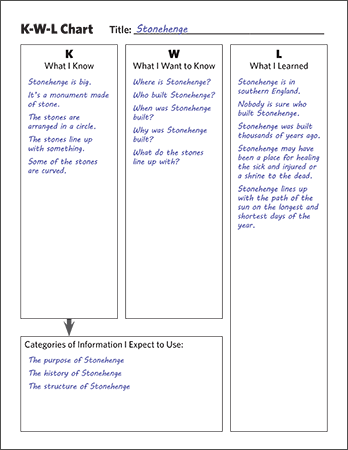 One thousand-W-50
At that place are three steps in the Yard-W-Fifty process (Ogle, 1986):
- What I Kat present: Before students read the text, ask them as a group to identify what they already know about the topic. Students write this listing in the "Grand" column of their K-W-L forms.
- What I Due westpismire to Know: Ask students to write questions virtually what they want to acquire from reading the text in the "W" cavalcade of their Thousand-W-L forms. For instance, students may wonder if some of the "facts" offered in the "K" column are true.
- What I Learned: As they read the text, students should look for answers to the questions listed in the "West" column and write their answers in the "L" cavalcade along with anything else they learn.
After all of the students take read the text, the teacher leads a discussion of the questions and answers.
Printable K-W-Fifty nautical chart (bare)
Graphic Organizers
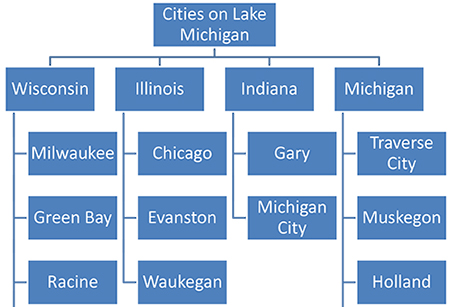
Graphic organizers provide visual representations of the concepts in expository text. Representing ideas and relationships graphically can help students empathize and call back them. Examples of graphic organizers are:
Tree diagrams that correspond categories and hierarchies
Tables that compare and contrast data

Time-driven diagrams that stand for the order of events
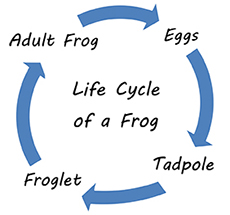
Flowcharts that represent the steps of a process
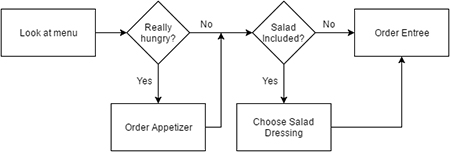
Teaching students how to develop and construct graphic organizers will require some modeling, guidance, and feedback. Teachers should demonstrate the process with examples get-go before students practice doing it on their own with teacher guidance and somewhen piece of work independently.
Strategies for Reading Comprehension in Read Naturally Programs
Several Read Naturally programs include strategies that support comprehension:
| Read Naturally Intervention Program | Strategies for Reading Comprehension | |||
|---|---|---|---|---|
| Prediction Step | Retelling Pace | Quiz / Comprehension Questions | Graphic Organizers | |
| Read Naturally Alive:
| ✔ | ✔ |
| |
| Read Naturally Encore:
| ✔ | ✔ |
| |
| Read Naturally GATE:
| ✔ | ✔ |
| |
| I Minute Reader Live:
|
| |||
| One Infinitesimal Reader Books/CDs:
|
| |||
| Take Aim at Vocabulary: A print-based program with audio CDs that teaches carefully selected target words and strategies for independently learning unknown words. Students work mostly independently or in teacher-led small groups of upwardly to six students.
|
| ✔ | ||
Bibliography
Honig, B., L. Diamond, and L. Gutlohn. (2013).Educational activity reading sourcebook, 2nd ed. Novato, CA: Loonshit Press.
Ogle, D. One thousand. (1986). Chiliad-West-50: A teaching model that develops active reading of expository text. The Reading Teacher 38(6), pp. 564–570.
Pressley, M. (1977). Imagery and children'due south learning: Putting the picture in developmental perspective. Review of Educational Inquiry 47, pp. 586–622.
Tierney, R. J. (1982). Essential considerations for developing bones reading comprehension skills.Schoolhouse Psychology Review 11(three), pp. 299–305.
Source: https://www.readnaturally.com/research/5-components-of-reading/comprehension
0 Response to "Which Reading Strategy Can Help You Identify the Author's Purpose?"
ارسال یک نظر