what did the europeans do to the muslims in india
The history of arrival and spread of Islam in Indonesia is unclear. One theory states it arrived straight from Arabia before the ninth century, while another credits Sufi merchants and preachers for bringing Islam to Indonesian islands in the twelfth or 13th century either from Gujarat in India or directly from the Middle Due east.[1] Before the arrival of Islam, the predominant religions in Indonesia were Hinduism (particularly its Shaivism tradition) and Buddhism.[ii] [three]
Initially, the spread of Islam was wearisome and gradual.[iv] Though historical documents are incomplete, the express evidence suggests that the spread of Islam accelerated in the 15th century, as the armed services ability of Melaka Sultanate in Malay Peninsular today Malaysia and other Islamic Sultanates dominated the region aided past episodes of Muslim coup such as in 1446, wars and superior command of maritime trading and ultimate markets.[4] [5] During 1511, Tomé Pires found animists and Muslims in the north declension of Java. Some rulers were Islamized Muslims, others followed the quondam Hindu and Buddhist traditions. By the reign of Sultan Agung of Mataram, most of the older Hindu-Buddhist kingdoms of Republic of indonesia, had at least nominally converted to Islam. The last one to do so was Makassar in 1605. After the fall of Majapahit empire, Bali became the refuge for the Hindu upper course, Brahmins and their followers that fled from Java, thus transferring the Hindu culture of Java to Bali.[6] [seven] [4] Hinduism and Buddhism remained extant in some areas of Eastward Java where it syncretized with animism. Their traditions as well continued in East and Primal Java where they earlier held a sway. Animism was besides adept in remote areas of other islands of Republic of indonesia.[viii]
The spread of Islam in eastern islands of Indonesia is recorded in 1605 when three Islamic pious men collectively known as Dato' Tallu came to Makasar, namely Dato'ri Bandang (Abdul Makmur or Khatib Tunggal), Dato'ri Pattimang (Sulaiman Ali or Khatib Sulung) and Dato'ri Tiro (Abdul Jawad or Khatib Bungsu). According to Christian Pelras (1985), Dato' Tallu converted Male monarch of Gowa and Tallo to Islam and changed their proper noun to Sultan Muhammad.
The spread of Islam was initially driven by increasing trade links exterior of the archipelago. Traders and the royalty of major kingdoms were usually the start to catechumen to Islam. Dominant kingdoms included Mataram in Cardinal Java, and the sultanates of Ternate and Tidore in the Maluku Islands to the east. By the end of the 13th century, Islam had been established in North Sumatra; by the 14th in northeast Malaya, Brunei, the southern Philippines and amongst some courtiers of Eastward Java; and the 15th in Malacca and other areas of the Malay Peninsula. Although information technology is known that the spread of Islam began in the west of the archipelago, the fragmentary evidence does not suggest a rolling wave of conversion through adjacent areas; rather, it suggests the process was complicated and slow.
Despite beingness i of the about significant developments in Indonesian history, historical evidence is fragmentary and generally uninformative such that understandings of the coming of Islam to Indonesia are limited; at that place is considerable argue amongst scholars about what conclusions tin can exist fatigued about the conversion of Indonesian peoples.[9] : 3 The primary evidence, at least of the earlier stages of the process, are gravestones and a few travellers' accounts, but these can only show that indigenous Muslims were in a certain place at a certain time. This evidence cannot explain more complicated matters such as how lifestyles were affected by the new religion or how deeply it afflicted societies. It cannot be assumed, for example, that because a ruler was known to be a Muslim, that the procedure of Islamisation of that area was consummate; rather the procedure was, and remains to this 24-hour interval, continuous in Indonesia. All the same, a articulate turning point occurred when the Hindu empire Majapahit in Java fell to the Islamised Demak Sultanate. In 1527, the Muslim ruler renamed newly conquered Sunda Kelapa as Jayakarta (meaning "precious victory") which was eventually contracted to Jakarta. Assimilation increased rapidly in the wake of this conquest.
Early history [edit]

[9] : three Before Islam was established in Indonesian communities, Muslim traders had been present for several centuries. Ricklefs (1991) identifies two overlapping processes past which the Islamisation of Indonesia occurred: (1) Indonesians came into contact with Islam and converted, and (2) strange Muslim Asians (Indians, Chinese, Arabs, etc.) settled in Indonesia and mixed with local communities. Islam is idea to have been nowadays in Southeast Asia from early in the Islamic era. From the fourth dimension of the 3rd caliph of Islam, 'Uthman' (644-656), Muslim emissaries and merchants were arriving in Cathay who must have passed through Indonesia sea routes from the Islamic world. It would have been through this contact that Arabic emissaries between 904 and the mid-12th century are thought to have go involved in the Sumatran trading country of Srivijaya.
The earliest accounts of the Indonesian archipelago date from the Abbasid Caliphate. According to those early accounts, the Indonesian archipelago was famous amidst early Muslim sailors, mainly due to its abundance of precious spice merchandise bolt such as nutmeg, cloves, galangal and many other spices.[10] [11]
The presence of foreign Muslims in Republic of indonesia does not, notwithstanding, demonstrate a significant level of local conversion or the establishment of local Islamic states.[9] : 3 The well-nigh reliable prove of the early spread of Islam in Indonesia comes from inscriptions on tombstones and a express number of travellers' accounts. The earliest legibly inscribed tombstone is dated AH 475 (Advertisement 1082), although as it belongs to a not-Indonesian Muslim, there is uncertainty as to whether it was transported to Java at a later fourth dimension. The first evidence of Indonesian Muslims comes from northern Sumatra; Marco Polo, on his way habitation from Prc in 1292, reported at least one Muslim town;[12] and the first evidence of a Muslim dynasty is the gravestone, dated AH 696 (AD 1297), of Sultan Malik al Saleh, the first Muslim ruler of Samudera Pasai Sultanate, with further gravestones indicating continued Islamic dominion. The presence of the Shafi'i schoolhouse of thought, which was to later on dominate Indonesia, was reported past Ibn Battuta, a Moroccan traveller, in 1346. In his travel log, Ibn Battuta wrote that the ruler of Samudera Pasai was a Muslim who performs his religious duties with utmost zeal. The schoolhouse of thought he used was Al-Shafi'i with like customs to those he had seen in India.[12]
Influences of Zheng He's voyages [edit]

Stamps of Indonesia commemorating Zheng He's voyages to secure the maritime routes, usher urbanization and assistance in creating a mutual prosperity.
Zheng He is credited to have settled Chinese Muslim communities in Palembang and forth the shores of Java, the Malay Peninsula, and the Philippines. These Muslims allegedly followed the Hanafi school in the Chinese language.[13] This Chinese Muslim customs was led by Hajji Yan Ying Yu, who urged his followers to digest and take local names.
Zheng He (1371–1433 or 1435), originally named Ma He, was a Hui courtroom eunuch, mariner, explorer, diplomat, and fleet admiral during People's republic of china's early Ming dynasty. Zheng commanded expeditionary voyages to Southeast Asia, Southern asia, Western Asia, and Due east Africa from 1405 to 1433. His larger ships stretched 400 feet in length (Columbus's Santa Maria, for comparison, was 85 feet). These carried hundreds of sailors on four tiers of decks. As a favorite of the Yongle Emperor, whose usurpation he assisted, he rose to the top of the regal hierarchy and served every bit commander of the southern capital Nanjing (the capital was later moved to Beijing by the Yongle Emperor). These voyages were long neglected in official Chinese histories only have become well known in China and abroad since the publication of Liang Qichao's Biography of Our Homeland's Neat Navigator, Zheng He in 1904. A trilingual stele left past the navigator was discovered on the island of Sri Lanka shortly thereafter.
Past region [edit]
It was initially believed that Islam penetrated Indonesian order in a largely peaceful way, (which is however largely true according to many scholars)[14] and from the 14th century to the terminate of the 19th century the archipelago saw well-nigh no organised Muslim missionary activity.[fifteen] Later on findings of scholars say that some parts of Java, i.e. Sundanese West Java and the kingdom of Majapahit on Eastward Coffee was conquered by Javanese Muslims. The Hindu-Buddhist Sunda Kingdom of Pajajaran was conquered by Muslims in the 16th century, while the Muslim-coastal and Hindu-Buddhist-interior part of East Java was frequently at war.[9] : eight Organised spread of Islam is also evident by the beingness of the Wali Sanga (ix holy patriarchs) who are credited for the Islamisation of Indonesia during this period.[9] [sixteen]
Northern Sumatra [edit]
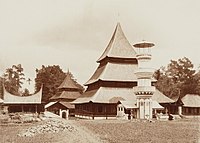
Firmer evidence documenting continued cultural transitions comes from two late-14th century gravestones from Minye Tujoh in North Sumatra, each with Islamic inscriptions but in Indian-type characters and the other Arabic. Dating from the 14th century, tombstones in Negara brunei darussalam, Terengganu (northeast Malaysia) and East Java are evidence of Islam'due south spread. The Trengganu stone has a predominance of Sanskrit over Arabic words, suggesting the representation of the introduction of Islamic police. According to the Ying-yai Sheng-lan: The overall survey of the sea'south shores' (1433) a written business relationship by Zheng He's chronicler and translator Ma Huan: "the main states of the northern part of Sumatra were already Islamic Sultanates. In 1414, he visited the Malacca Sultanate, its ruler Iskandar Shah was Muslim and also his people, and they were very strict believers".
In Kampong Pande, the tombstone of Sultan Firman Syah, the grandson of Sultan Johan Syah, has an inscription stating that Banda Aceh was the capital of the Kingdom of Aceh Darussalam and that information technology was built on Friday, i Ramadhan (22 Apr 1205) by Sultan Johan Syah after he defeated the Hindu and Buddhist Kingdom of Indra Purba whose capital was Bandar Lamuri. The establishment of further Islamic states in North Sumatra is documented by late 15th- and 16th-century graves including those of the first and 2d Sultans of Pedir; Muzaffar Syah, buried (1497) and Ma'ruf Syah, buried (1511). Aceh was founded in the early 16th century and would later become the most powerful North Sumatran land and one of the near powerful in the whole Malay archipelago. The Aceh Empire'southward first sultan was Ali Mughayat Syah whose tombstone is dated (1530).
The volume of Portuguese apothecary Tomé Pires that documents his observations of Coffee and Sumatra from his 1512 to 1515 visits, is considered 1 of the most of import sources on the spread of Islam in Indonesia. In 1520, Ali Mughayat Syah started military campaigns to dominate the northern part of Sumatra. He conquered Daya, and submitted the people to Islam.[17] Further conquests extended downwardly the east coast, like Pidie and Pasai incorporating several pepper-producing and gold-producing regions. The addition of such regions ultimately led to internal tensions inside the Sultanate, equally Aceh's force was as a trading port, whose economic interests vary from those of producing ports.
At this time, according to Pires, most Sumatran kings were Muslim; from Aceh and south along the east coast to Palembang the rulers were Muslim, while south of Palembang and effectually the southern tip of Sumatra and up the westward declension, most were not. In other Sumatran kingdoms, such every bit Pasai and Minangkabau the rulers were Muslim although at that stage their subjects and peoples of neighbouring areas were not, still, it was reported that the religion was continually gaining new adherents.
After the inflow of the Portuguese colonials and the tensions that followed regarding control of the spice merchandise, the Acehnese Sultan Alauddin al-Kahar (1539–71) sent an embassy to the Ottoman Sultan Suleiman the Magnificent in 1564, requesting Ottoman support against the Portuguese Empire. The Ottomans then dispatched their admiral Kurtoğlu Hızır Reis he ready sail with a force of 22 ships conveying soldiers, military equipment and other supplies. According to accounts written by the Portuguese Admiral Fernão Mendes Pinto, the Ottoman fleet that first arrived in Aceh consisted of a few Turks and largely of Muslims from the ports of the Indian Sea.[18]
East Sumatra and Malay peninsula [edit]
Founded around the beginning of the 15th century by Sultan Parameswara, the great Malay trading state The Sultanate of Malacca founded by Sultan Parameswara, was, as the most important trading centre of the Southeast Asian archipelago, a center of strange Muslims, and it thus appears a supporter of the spread of Islam. Parameswara, himself is known to have converted to Islam, and taken the name Iskandar Shah after the arrival of the Hui-Chinese Admiral Zheng He. From Malacca and elsewhere, gravestones survive showing not only its spread in the Malay archipelago but as the organized religion of a number of cultures and their rulers in the tardily 15th century.
Central and eastern Java [edit]
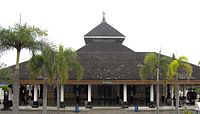
Grand Mosque of Demak, the get-go Muslim state in Coffee
Inscriptions in Old Javanese rather than Arabic on a significant series of gravestones dating back to 1369 in East Java, indicate that these are almost certainly Javanese, rather than foreign Muslims. Due to their elaborate decorations and proximity to the site of the old Hindu-Buddhist Majapahit upper-case letter, Damais concludes that these are the graves of very distinguished Javanese, perhaps fifty-fifty royalty.[nineteen] This suggests that some of the Javanese aristocracy adopted Islam at a time when the Hindu-Buddhist Majapahit was at the top of its celebrity.
Ricklefs (1991) argues that these eastward Javan gravestones, sited and dated at the non-coastal Majapahit, bandage dubiety on the long-held view that Islam in Java originated on the coast and represented political and religious opposition to the kingdom. As a kingdom with far-reaching political and trading contacts, Majapahit would have almost certainly been in contact with Muslim traders, notwithstanding there is conjecture over the likelihood of its sophisticated courtiers beingness attracted to a religion of merchants. Rather, mystical Sufi Muslim teachers, possibly claiming supernatural powers (keramat), are thought to exist a more likely agent of religious conversion of Javanese court elites, who had long been familiar with aspects of Hindu and Buddhist mysticism.[nine] : 5
Key and East Java, the areas where the ethnic Javanese lived, was still claimed by the Hindu-Buddhist king living in the interior of east java at Daha. The coastal areas such every bit Surabaya were, however, Islamised and were oft at state of war with the interior, except for Tuban, which remained loyal to the Hindu-Buddhist king. Some of the coastal Muslim lords were converted Javanese, or Muslim Chinese, Indians, Arabs, and Malays who had settled and established their trading country on the coast. This state of war betwixt the Muslim-declension and Hindu-Buddhist interior likewise continued long after the fall of the Majapahit by the Demak Sultanate, and the animosity also continues long after both regions had adopted Islam.[ix] : 8
When the peoples of the n declension of Coffee adopted Islam is unclear. Chinese Muslim, Ma Huan and envoy of the Yongle Emperor of Cathay,[12] visited the Java coast in 1416 and reported in his book, Ying-yai Sheng-lan: The overall survey of the ocean'southward shores' (1433), that there were but three types of people in Java: Muslims from the west, Chinese (some Muslim) and the heathen Javanese.[20] Since the east Javan gravestones were those of Javanese Muslims fifty years before, Ma Huan's report indicates that Islam may accept indeed been adopted by Javanese courtiers before the coastal Javanese.
An early on Muslim gravestone dated AH 822 (Ad 1419) has been plant at Gresik an East Javanese port and marks the burying of Malik Ibrahim.[21] : 241 As it appears, however, that he was a non-Javanese foreigner, the gravestone does non provide prove of coastal Javanese conversion. Malik Ibrahim was, however, according to Javanese tradition one of the first nine apostles of Islam in Java (the Wali Sanga) although no documentary evidence exists for this tradition. In the late 15th century, the powerful Majapahit empire in Java was at its pass up. After had been defeated in several battles, the final Hindu kingdom in Java cruel under the rising power of Islamised Kingdom of Demak in 1520.
The Da'wah of Walisongo [edit]
The question is: why simply in the catamenia of 40–fifty years, Islam tin be received so widespread in Java, whereas earlier it was very difficult to develop? One significant key-factor of the success of Da'wah of Walisongo is how the Walisongo develop an abandoned civilisation of Majapahit into a new culture whose roots class the Majapahit but with Islamic characteristics. For instance, until the early Demak era, society is divided into 2 major groups, such as Majapahit era. Outset, the Group of Gusti, namely people who live in the palace. Secondly, the Group of Kawula, people who live outside the palace.
Gusti ways master, Kawula means slaves or servants, who only have the correct to lease, non the right of buying, considering the right of ownership is but belongs to the people with the social status of (Gusti). In the era of Majapahit, all property is owned by the palace (country, or nation, or the kingdom). And if the rex wants to give a deserving bailiwick, so by the King'southward society that person will be given sima country or perdikan land (fief). This also ways, if he had been a Kawula, his social status will ascension, and he volition get a Gusti, and he besides has the right of buying as he was given the simah state (fief).
Walisongo, especially Sheikh Siti Jenar and Sunan Kalijaga, created a new perspective in the cultural and society structure. From the cultural and society structure of "gusti and kawula", they introduce the new community construction which is so-called "Masyarakat", derived from the Standard arabic term of Musharaka, which means the community of equal and mutual cooperation. Information technology is proven by the absence of the term of "masyarakat", "rakyat", then on in the Javanese Kawi vocabulary. It's a new term that was brought by Walisongo during their Dha'wah.
One of the methods that were used by the Walisongo is by irresolute the mindset of the order. People with social status of Gusti pronoun themselves as: intahulun, kulun or ingsun. While the people with social status of Kawula pronoun themselves as: kula or kawula (Javanese), abdi (Sundanese), saya or sahaya (Sumatran): hamba or ambo (Minangkabau). Walisongo changes all those self pronunciation or designation which indicates the meaning of slaves, and replaced it with the term of ingsun, aku, kulun, or awak, and other designations that exercise not represent the identity of slaves or persons with lower social status. That is the concept of order of Walisongo, society or community of equal and mutual cooperation, which does not possess any discriminations nor discriminate the terms of self designation between field of study classes such "gusti and kawula", which is chosen "Masyarakat". In present days, the term of kula, ambo, abdi, hamba, sahaya or saya, are still being used for the purpose of showing respect toward others, for case: while speaking toward someone older, parents, strangers, and and so on.
At the time of Majapahit, in add-on to class gusti, people practise not accept property rights, such as houses, cattle, so on, because all of them belonged to the palace. If the palace had intent, similar wanting to build a bridge or temple and require the cede, the children of class subjects taken and victimized. By changing the construction of social club, class subjects tin can finally rejected because of the equality of the new society system.
The Javanese in the era of Majapahit are known to be very arrogant. Their principle of life is "Adigang Adigung Adiguna" (superior in power, authority, and cognition). They are very proud to have been able to subdue and or humiliate others. According to the testimony of Antonio Pigafetta, at that time, there's no i is as arrogant exceed the Javanese. If they were walking, and there's also people from some other nation who walk at a higher place, they volition be ordered to get down. and if they refuse, they will exist killed. That is the character of the Javanese. Then in onetime Javanese Kawi, at that place's no term of "kalah" ("lose"). If someone at odds with others, then at that place is just "win" or "dead". As Ma Huan noted, in Chao-wa (Coffee) if a man touches their head with his paw, or if in that location is a misunderstanding about money at a auction, or a battle of words when they are crazy with drunkenness, they at once pull out their knives and stab [each other]. He who is stronger prevails. When [1] man is stabbed to death, if the [other] man runs away and conceals himself for iii days earlier emerging, then he does not forfeit his life; [just] if he is seized at the very moment [of the stabbing], he too is instantly stabbed to death. The state has no [such] punishment as flogging; no [matter whether] the offence be corking or modest, they tie both [the offender's] easily backside his back with a fine rattan, and hustle him away for several paces, then they take a pu-la-t'ou and stab the offender once or twice in the small of the back or in the floating ribs, causing instant death. According to the local custom of the land no day [passes] without a human being being put to death; [it is] very terrible.[22]
Walisongo then develop the terms of "ngalah" ("NgAllah"). It is not derived from the Indonesian word "kalah" but from the Javanese prefix "Ng" which means toward (a purpose, and or destination). For example: ng-alas (toward the forest), ng-awang (toward the clouds), and Ng-Allah ways toward Allah (tawakkal), the word "ngalah" itself was then used by the Javanese as an expression in fugitive disharmonize. The other prove of the arrogance of the Javanese is represented during the time when envoys from China (Meng Eleven) came in order to deliver a message from their king (Kubilai Khan) to the king of Singasari (Kertanegara). The messages ordered Kertanegara to submit toward their kingdom. And in render, Meng Eleven (the Chinese envoy) was wounded, humiliated, and sent dorsum to People's republic of china past Kertanegara (it is said that his ear was cut off instantly past Kertanegara himself). The term of Carok in Madura is also derived from the aboriginal Javanese Tradition. Carok in Javanese Kawi means fighting; Warok means a fighter; and Ken Arok means the leader of fighters. Therefore, Walisongo introduced a new term such as "sabar" (patient), "adil" (off-white), 'tawadhu', including "ngalah" or ngAllah (avoiding conflict).[ citation needed ]
Walisongo sees that Hinduism and Buddhism actually were only embraced by the Gusti society within the palaces[ commendation needed ]. The common religion that generally embraced by the full general population exterior the palace is Kapitayan, a religion whose devotee toward Sang Hyang Taya. Taya means "suwung" (empty). God of Kapitayan is abstract, it can non exist described. Sang Hyang Taya is defined just as "tan keno kinaya ngapa", it tin non exist seen, thought, nor imagined. And the might of Sang Hyang Taya whose then represent in various places, such as in stone, monument, copse, and in many other places in this globe. Therefore, they makes their offerings over those place, non considering they worshiping the stones, trees, monuments, or anything else, but they did it every bit their devotion toward Sang Hyang Taya whose his might is represent in all over those places. An exactly similar concept of Brahman is institute in Hinduism.[23]
This Kapitayan religion, is the ancient religion, in which is studied in the archaeological written report, whose its archeological remains and legacy in Western terminology is known equally dormant, menhirs, sarcophagus, and many others in which indicates that at that place is an ancient faith around that place. And by the Dutch historian, this religion is referred to every bit animism and dynamism, considering it worships trees, rocks, and spirits. Meanwhile, co-ordinate to Ma Huan, such practices are called as nonbeliever.[24]
These Kapitayan'due south religious values was and so adopted by the Walisongo in spreading Islam toward the regions. Because the concept of tawhid in Kapitayan is basically aforementioned with the concept of tawhid in Islam: the term of "Tan keno kinaya ngapa" in Kapitayan ("can't exist seen, can't be thought, tin't be imagined, He is beyond everything"), have the same equal meaning as "laisa kamitslihi syai'united nations" in Islam ("There is nothing like unto Him"; Qur'an Surah Ash-Syura chapter 42 verse 11).[24]
Walisongo besides utilize the term "Sembahyang" (worshipping Sang Hyang Taya in Kapitayan) in introducing the term of "Shalat" in Islam. In term of places for worship or praying, Walisongo too using the term Sanggar in Kapitayan, which represents a four-square building with an empty pigsty on its wall every bit the symbol of Sang Hyang Taya in Kapitayan, not arca or statues as in Hindu or Buddhism. This term of place for praying or worshipping in Kapitayan also used past Walisongo by the proper noun "Langgar" represents the term of Masjid in Islam".[24]
There's besides a ritual in form of not eating from morning upward until nighttime in Kapitayan, which is called as Upawasa (Puasa or Poso). Incidentally, the ritual of fasting in Hinduism is likewise called "Upawasa" or "Upavasa".[25] Instead of using the term of fasting or Siyam in Islam, Walisongo used the term of Puasa or Upawasa from the Kapitayan in describing the ritual. The term of Poso Dino Pitu in Kapitayan whose means fasting on the day of the second and the fifth day in which is equal to seven days of fasting, is very similar with the form of fasting on Mondays and Thursdays in Islam. The Tradition of "Tumpengan" of Kapitayan was also existence kept past the Walisongo under the Islamic perspective as known as "Sedekah". This is the meaning of the terminology in which Gus Dur (Indonesian fourth president) mentioned equally "mempribumikan Islam" (Indigenize Islam).[26] [27]
At the time of Majapahit, there is a ceremony which is called as "Sraddha", a ceremony that being held 12 years after a person's death. At that place is a time in the Majapahit history, during the Sraddha ceremony a King of Majapahit (Bhre Pamotan Sang Sinagara), a poet namely Mpu Tanakung, composed the "Kidung of Banawa Sekar" (The Carol of Flowers Boat), to draw how the ceremony was carried out with full opulence and grandeur. This tradition was then called by club around the lakes and beach with the term Sadran or Nyadran (derived from the word Sraddha).[28] Walisongo who derived from Champa as well brought religious traditions, such as ceremonies of three days, seven days, 40 days, 10 days, and 1000 days after someone's death. This is a tradition in which derived from Campa, not a native Javanese tradition, nor the Hindu tradition. Because these traditions also exist in parts of Key Asia, such as Uzbekistan and Kazakhstan. In the books of Tradition of Champa, such tradition has already exist since a very long fourth dimension ago.
In the history of Majapahit's superstition, in that location are only Yaksa, Pisacas, Wiwil, Rakshasha, Gandharwa, Bhuta, Khinnara, Widyadhara, Ilu-Ilu, Dewayoni, Banaspati, and ancestral spirits, in which known by the people of Majapahit. The people of Majapahit was very rational. They all were sailors and go to know people from all beyond the globe such equally Japan, India, Mainland china, Africa, Arabia, Pacific Ocean and many other place. In the Islamic era that detracted from Champa a lot of new superstition appears, such as pocong. This is clearly derived from the Muslim faith, because in Majapahit the dead was burned and non covered with sheet. There are also many other superstition like kuntilanak, tuyul, including the fable of Nyai Roro Kidul or Queen of the Southern Sea who came after.
During the Dha'wah of Walisongo, Islam was spread without any force of arms, not even a single drip of blood was spilled. Only afterwards the Dutch flow, peculiarly after the Diponegoro War, the Dutch actually run out of funds, they even owe millions of Guldens because of it. And fifty-fifty afterward Prince Diponegoro arrested, his remains were never subject. The Dutch finally deconstructing the stories most Walisongo, as in Babad Kediri. From this Babad Kediri, it was then emerged the book chronicle of Darmo Gandul and Suluk Gatholoco. the one who authored the book is named Ngabdullah, a person from Pati East Java, who considering of poverty, making it lapsed and leaves Islam. He later on renamed past the name of Ki Tunggul Wulung and settled in Kediri.
In the essay cobweb, there are many stories[ weasel words ] that contrary to historical fact, such as Demak attacked Majapahit 1478 and the emergence of a fictional grapheme Sabdo Palon Naya Genggong who swore that 500 years after the attack, Majapahit will bounce back. Nevertheless according to the more authentic script and more than ancient, in that twelvemonth that attacked Majapahit is King Girindrawardhana, the Hindu king of Kediri. And because of the very strong influence of that tale, it makes President Soeharto, the 2nd president of Republic of indonesia was very confident and so that he sets pass of Aliran Kepercayaan (Beliefs) in Indonesia in the year 1978 (500 years after 1478), equally a symbol of truth of the adjuration of Sabdo Palon about the resurrection of Majapahit.
Secretly, it turns out the Dutch brand history essay of themselves to misfile the struggle of Muslims, especially the followers of Prince Diponegoro. The Dutch even made Babad Tanah Jawi of their ain version, which is different from the original Babad Tanah Jawi. For instance, the text of the Kidung Sunda, described the event of Bubad War, information technology is said that Gajah Mada kill the King of Sunda and his unabridged family. This is what makes the people of Sunda harbored a grudge against the people of Java. Tracking back from its historical record, the text itself just appeared in Bali in 1860, made past the guild of the Dutch. Sunda is a great kingdom, if such an issue was truly ever happened, it must have been written by the Kingdom of Sunda. The Kingdom of Sunda was very detail in describing its historical records. Even the Traditions of Sunda was written in very detail in the manuscript of "Sanghyang Siksa Kanda ng Karesyan". How come such corking event was never mentioned fifty-fifty once in the Chronicle of Sunda (Babad Sunda). The event itself was never mentioned in the Chronicles of Majapahit, nor in any other historical records. Again, this is the tactic of the Dutch in dividing the order by creating a imitation history as part of the Dutch policy "Divide and Conquer". From all of the distortion of history, all must accept originated from a script written by the Dutch post-Diponegoro State of war.
In metallurgical technology smelting iron and steel, for example, people of Majapahit had already possess the ability of creating the Majapahit'south heritage, such as keris, spears, arrows, fifty-fifty barunastra, a giant tipped steel arrows that functioned like an underwater torpedo, in which when it was fired, it take the ability to penetrate and bilge the ship. Demak kingdom as the descendants of Majapahit has the power to create a large quotient of cannons in which exported to Malacca, Pasai, even Nippon. The fact that Japanese bought guns from Demak sourced from the record of the Portuguese, during the conquered of the Port of Malacca, the Portuguese intelligences sourced that the Malacca fortress was complemented past big-size of cannons imported from Coffee. When the Portuguese was merely newly arrived from Europe, their ships were uprooted by cannon fires when approaching the port of Malacca. The proof of this can be seen in Fort Surosowan Banten, where in forepart of information technology there is a giant cannon named "Ki Amok". As an analogy of the magnitude of the cannon, people can become into the cannon holes. Fifty-fifty the majestic seal of the Kingdom of Demak still conspicuously attached on the cannon, which is made in Jepara, a region in the Kingdom of Demak whose famous by its craftsmanship. The term of "bedil besar" ("big guns") and "jurumudi ning bedil besar" ("the driver of the large guns") describes "cannon" and "cannon operators". That was the military engineering science during the era of Walisongo.
Majapahit famous puppet evidence is "Wayang Beber", whereas during the Walisongo era is "Wayang Kulit". Walisongo as well changed the story of Mahabharata his in which is different from the original version of India. In the Indian version, Five Pandavas have one married woman, Draupadi. This ways that the concept of polyandry. Walisongo change this concept past telling that Draupadi was the wife of Yudhishthira, the eldest brother. Werkudara or Bima has a wife namely Arimbi, who later he married over again with Dewi Nagagini who have children Ontorejo and Ontoseno, and so on. Illustrated that all the Pandavas were polygamy. Whereas the original version, Draupadi polyandry with five Pandavas. Similarly, in the story of Ramayana. Hanuman has two fathers, namely Male monarch Kesari Maliawan and God Bayu. By Walisongo, Hanuman referred to every bit the son of God Bayu. Walisongo even make the full-blooded that the gods were descendants of Adam. This can exist seen on the Pakem Pewayangan (the grip of puppet testify) Ringgit Purwa at Pustaka Raja Purwa in Solo, which is a grip for every puppet masters in Java.[29] [30] So the grip that was used by the puppeteers in Java was the Pakem derived from Walisongo, not Republic of india. This puppet spectacle, not just as an entertainment but also functioned as guidance in the propagation of Islam by Walisongo.
In context of literary, the kingdom of Majapahit had already created Kakawin and Kidung. Past Walisongo, this literary richness was then enriched by the making of multifariousness of song compositions, such every bit "Tembang Gedhe" (great vocal composition), "Tembang Tengahan" (mid song composition), and "Tembang Alit" (curt song limerick). Macapat flourished in coastal areas. Kakawin and Kidung could only be understood by a poet. But for the Tembang, even an illiterate people can sympathise.[31] [32] This is the method of Walisongo Propagation through the arts and culture.[33]
Another case of the Dha'wah of Walisongo is Slametan which is developed past Sunan Bonang and then followed past the other Sunans. In the Tantrayana (Tantric) religion embraced by kings of Nusantara archipelago, there'due south a sect in that Tantric faith which is called the Bhairawa Tantra sect that worships the Goddess of Globe, Goddess Durga, Goddess Kali, and others Gods. They take a rituals where they were creating a circle called Ksetra. The largest Ksetra in Majapahit is Ksetralaya, the place today is called Troloyo.
The ritual ceremony itself was known as Upacara Panchamakara (the ceremony of 5 ma, the malima), namely Mamsya (meat), Matsya (fish), Madya (wine), Maithuna (sexual intercourse), and Mudra (meditation). Men and women formed a circle and all naked. In the center is provided meat, fish, and vino. After eating and drinking, they have sexual intercourse (maituna). After satisfying various desires, they meditated. For higher levels, they were using human flesh for Mamsya replacing meat, Sura fish (shark) for Matsa, and human claret for Madya replacing wine.
At Indonesian National Museum in Jakarta, there is a statue of a graphic symbol named Adityawarman elevation of 3 meters and stands on a pile of skulls. He is the priest of the Bhairawa Tantra, the 1 who performed the teaching of malima. He was inaugurated and so became the Bhairawa priest carrying the championship of Wisesa Dharani, the ruler of the earth. The statue described that he sat on a pile of hundreds of corpses, drinking blood, and laughing uproariously.
Witnessing such situation, Sunan Bonang created a like upshot. He entered the center of Bhairawa Tantra in Kediri. Equally formerly the centre of the Bhairawa Tantra, no wonder if the slogan of the Metropolis of Kediri now is Canda Bhirawa. During his Dha'wah in Kediri, Sunan Bonang stayed in the west of the river, in the village of Singkal Nganjuk. There he held a similar ceremony, made the like circle, but all of the participants were all males, in the center of the circle there is the food, and then they pray together. This is called the Kenduri Tradition (festivity tradition) or Slametan. Developed from village to village to match the ceremony of malima (Panchamakara). Therefore, Sunan Bonang was also known as Sunan Wadat Cakrawati, as the leader or imam of Chakra Iswara (Cakreswara).
Therefore, in the rural areas, people tin can be considered as a Muslim if he'southward already stated the Islamic creed, circumcised, and Slametan. And so malima was originally not Maling (thievery), Maen (gambling), Madon (adultery), Madat (consuming opium), and Mendem (drunk), simply the 5 elements of Panchamakara. Islam was and then growing even faster because the people do not desire their children get victimized every bit in Bhairawa Tantra. Then, they prefer to join Slametan with the aim of "slamet" (safety). This is the manner of Walisongo spreads Islam without violence.
In conclusion, about 800 years Islam entered the archipelago, since the twelvemonth 674 until Walisongo era in 1470, but has yet to exist accepted by society en masse. It was and so later the era of Walisongo, Islam developed so widespread in the archipelago. And until now, the teaching Walisongo is notwithstanding run by the majority of Indonesian Muslims.
Western Coffee [edit]
Pires' Suma Oriental reports that Sundanese-speaking West Java was not Muslim in his day, and was indeed hostile to Islam.[9] A Muslim conquest of the surface area occurred later in the 16th century. In the early 16th century, the Central and East Coffee (home of the Javanese) were still claimed by the Hindu-Buddhist king living in the interior of East Java at Daha (Kediri). The northward coast was, however, Muslim every bit far as Surabaya and were often at state of war with the interior. Of these littoral Muslim lords, some were Javanese who had adopted Islam, and others were not originally Javanese but Muslim traders settling along established trading routes including Chinese, Indians, Arabs and Malays. According to Piers, these settlers and their descendants then admired Javanese Hindu-Buddhist culture that they emulate its style and were thus themselves becoming Javanese.
In his study of the Banten Sultanate, Martin van Bruinessen focuses on the link between mystics and royalty, contrasting that Islamisation procedure with the one which prevailed elsewhere in Java: "In the case of Banten, the indigenous sources associate the tarekats not with merchandise and traders simply with kings, magical ability and political legitimation."[34] He presents evidence that Sunan Gunungjati was initiated into the Kubra, and Shattari, orders of sufism.
Other areas [edit]
There is no show of the adoption of Islam by Indonesians before the 16th century in areas outside of Coffee, Sumatra, the sultanates of Ternate and Tidore in Maluku, and Brunei and the Malay Peninsula.
Indonesian and Malay legends [edit]
Although fourth dimension frames for the establishment of Islam in Indonesian regions tin can exist broadly determined, the historical primary sources cannot answer many specific questions, and considerable controversy surrounds the topic. Such sources do not explicate why significant conversions of Indonesians to Islam did not begin until after several centuries of foreign Muslims visiting and living in Republic of indonesia, nor practise they adequately explain the origin and development of Indonesia'due south idiosyncratic strains of Islam, or how Islam came to be the ascendant religion in Republic of indonesia.[9] : eight To fill up these gaps, many scholars turn to Malay and Indonesian legends surrounding Indonesian conversion to Islam. Ricklefs argues that although they are not reliable historical accounts of actual events, they are valuable in illuminating some of the events is through their shared insights into the nature of learning and magical powers, strange origins and trade connections of the early teachers, and the conversion process that moved from the elite downwards. These besides provide insight into how afterwards generations of Indonesians view Islamisation.[9] : 8–11 These sources include:
- Hikayat Raja-raja Pasai ("The Story of the kings of Pasai") – an Erstwhile Malay text that tells how Islam came to "Samudra" (Pasai, northern Sumatra) where the first Indonesian Islamic state was founded.
- Sejarah Melayu ("Malay History") – an Old Malay text, which like Hikayat Raja-raja Pasai tells the story of the conversion of Samudra, merely besides tells of the conversion of the Male monarch of Malacca.
- Babad Tanah Jawi ("History of the land of Java") – a generic name for a large number of manuscripts, in which the first Javanese conversions are attributed to the Wali Sanga ("nine saints").
- Sejarah Banten ("History of Banten") – A Javanese text containing stories of conversion.
Of the texts mentioned hither, the Malay texts depict the conversion process every bit a significant watershed, signified by formal and tangible signs of conversion such as circumcision, the Confession of Organized religion, and the adoption of an Standard arabic name. On the other hand, while magical events still play a prominent role in the Javanese accounts of Islamisation, such turning points of conversion as in the Malay texts are otherwise not as evident. This suggests a more adsorptive process for the Javanese,[9] : nine that is consistent with the significantly larger syncretic element in contemporary Javanese Islam in comparison to the relatively orthodox Islam of Sumatra and Malaysia.
Flags of the Sultanates in the East Indies (Indonesia) [edit]
-

Flag of Banten Sultanate
-

Flag of Cirebon Sultanate
-

Flag of Mataram Sultanate
-

Flag of Aceh Sultanate
-

Flag of Gowa Sultanate
-

Flag of Surakarta Sunanate
-

Flag of Demak Sultanate
See also [edit]
- Islam in Indonesia
- History of Indonesia
- Mosques in Indonesia
- Spread of Islam in Southeast Asia
- Spread of Islam
References [edit]
- ^ Nina Nurmila (31 January 2013). Jajat Burhanudin, Kees van Dijk (ed.). Islam in Republic of indonesia: Contrasting Images and Interpretations. Amsterdam University Press. p. 109. ISBN9789089644237.
- ^ Jan Gonda (1975). Handbook of Oriental Studies. Department 3 Southeast Asia, Religions. BRILL Academic. pp. 3–20, 35–36, 49–51. ISBN90-04-04330-vi.
- ^ Ann R. Kinney; Marijke J. Klokke; Lydia Kieven (2003). Worshiping Siva and Buddha: The Temple Art of Due east Java. University of Hawaii Press. pp. 21–25. ISBN978-0-8248-2779-3.
- ^ a b c Audrey Kahin (2015). Historical Dictionary of Indonesia. Rowman & Littlefield Publishers. pp. 3–five. ISBN978-0-8108-7456-5.
- ^ 1000.C. Ricklefs (2008). A History of Mod Indonesia Since C.1200. Palgrave Macmillan. pp. 17–nineteen, 22, 34–42. ISBN978-1-137-05201-8.
- ^ Robert Pringle (2010). Agreement Islam in Indonesia: Politics and Variety. University of Hawaiʻi Printing. pp. 29–thirty, 37. ISBN978-0-8248-3415-9.
- ^ I. Gusti Putu Phalgunadi (1991). Development of Hindu Civilisation in Bali: From the Earliest Period to the Nowadays Time. Bali Indonesia: Prakashan. pp. vii, 57–59. ISBN978-81-85067-65-0.
- ^ Robert Pringle (2010). Understanding Islam in Indonesia: Politics and Diversity. University of Hawaiʻi Printing. p. 37. ISBN978-0-8248-3415-9.
- ^ a b c d e f 1000 h i j chiliad Ricklefs, M.C. (1991). A History of Modern Indonesia since c.1300, second Edition. London: MacMillan. ISBN0-333-57689-vi.
- ^ "Geographic Spice Index". Gernot-katzers-spice-pages.com. Retrieved 19 Nov 2021.
- ^ Ibn Khordadbeh
- ^ a b c Raden Abdulkadir Widjojoatmodjo (November 1942). "Islam in holland East Indies". The Far Eastern Quarterly. 2 (one): 48–57. doi:10.2307/2049278. JSTOR 2049278.
- ^ AQSHA, DARUL (13 July 2010). "Zheng He and Islam in Southeast Asia". The Brunei Times. Archived from the original on nine May 2013. Retrieved 28 September 2012.
- ^ Azra, Azyumardi (2006). Islam in the Indonesian Earth: An Account of Institutional Germination. Mizan Pustaka. pp. iii–4. ISBN978-979-433-430-0.
- ^ Nieuwenhuijze (1958), p. 35.
- ^ Ricklefs, M.C. History of Mod Indonesia Since c.1200. P.8.
- ^ http://www.kitlv.nl/pdf_documents/asia.acehnese.pdf [ dead link ]
- ^ Azra, Azyumardi (2006). Islam in the Indonesian world: an account of institutional formation. Mizan Pustaka. p. 169. ISBN9789794334300.
- ^ Damais, Louis-Charles, 'Études javanaises, I: Les tombes musulmanes datées de Trålåjå.' BEFEO, vol. 54 (1968), pp. 567-604.
- ^ Ma Huan's, Ying-yai Sheng-lan: The overall survey of the ocean'south shores' (1433). Ed. and transl. J.V.Chiliad. Mills. Cambridge: University Press, 1970
- ^ Cœdès, George (1968). The Indianized states of Southeast Asia. Academy of Hawaii Press. ISBN9780824803681.
- ^ Feng Ch'eng-Chün, J. V. M. MILLS (1970). Ma Huan's Ying-Yai Sheng-Lan : 'The Overall Survey of The Oceans Shores' [I433] (PDF). The states of America: Cambridge University Printing. p. 88. Retrieved 24 February 2016.
- ^ Borohhov, Dmitri. "What Is Brahman, Omnipresent Consciousness? Definition of the Sanskrit Word". Ananda . Retrieved 20 Nov 2019.
- ^ a b c Galbinst, Yuri (2019). Islam: Dari Republic of indonesia ke Dinasti Safawi. Cambridge: Cambridge Stanford Books. pp. 13–14.
- ^ "Upavasa". Banglapedia . Retrieved 20 November 2019.
- ^ Arif, Mahmud (1 January 2008). Pendidikan Islam transformatif (in Indonesian). PT LKiS Pelangi Aksara. ISBN9789791283403.
- ^ Azra, Azyumardi (1 Jan 2005). Dari Harvard hingga Makkah (in Indonesian). Penerbit Republika. ISBN9789793210520.
- ^ Marr, David G.; Milner, Anthony Crothers (1 January 1986). Southeast Asia in the 9th to 14th Centuries. Institute of Southeast Asian Studies. ISBN9789971988395.
- ^ Florida, Nancy K. (one January 1993). Javanese Literature in Surakarta Manuscripts: Introduction and manuscripts of the Karaton Surakarta. SEAP Publications. ISBN9780877276036.
- ^ Najawirangka (Mas Ngabei.) (1 January 1966). Serat pakem ringgit purwa tjaking pakeliran: lampahan Palasara (in Javanese). Mahabarata.
- ^ Muljono, Untung (ane March 2012). "PENDIDIKAN NILAI LUHUR MELALUI TEMBANG (LAGU) DOLANAN ANAK". Jurnal Online ISI Yogyakarta . Retrieved 24 Feb 2016.
- ^ "Walisongo (three): Tembang, Cara Lembut Sunan Giri Siarkan Islam | Dream.co.id". Dream.co.id . Retrieved 25 February 2016.
- ^ "Tembang Karya Walisongo akan Ditampilkan dalam Resepsi HUT RI". NU Online. Nahdlatul Ulama Online. Retrieved 24 February 2016.
- ^ Martin van Bruinessen (1995). "Shari'a courtroom, tarekat and pesantren: religious institutions in the sultanate of Banten". Archipel. fifty: 165–200. doi:x.3406/arch.1995.3069. Archived from the original on 26 October 2009.
Bibliography [edit]
- Van Nieuwenhuijze, C.A.O. (1958). Aspects of Islam in Postal service-Colonial Indonesia. The Hague: West. van Hoeve Ltd.
Source: https://en.wikipedia.org/wiki/Spread_of_Islam_in_Indonesia
0 Response to "what did the europeans do to the muslims in india"
ارسال یک نظر